
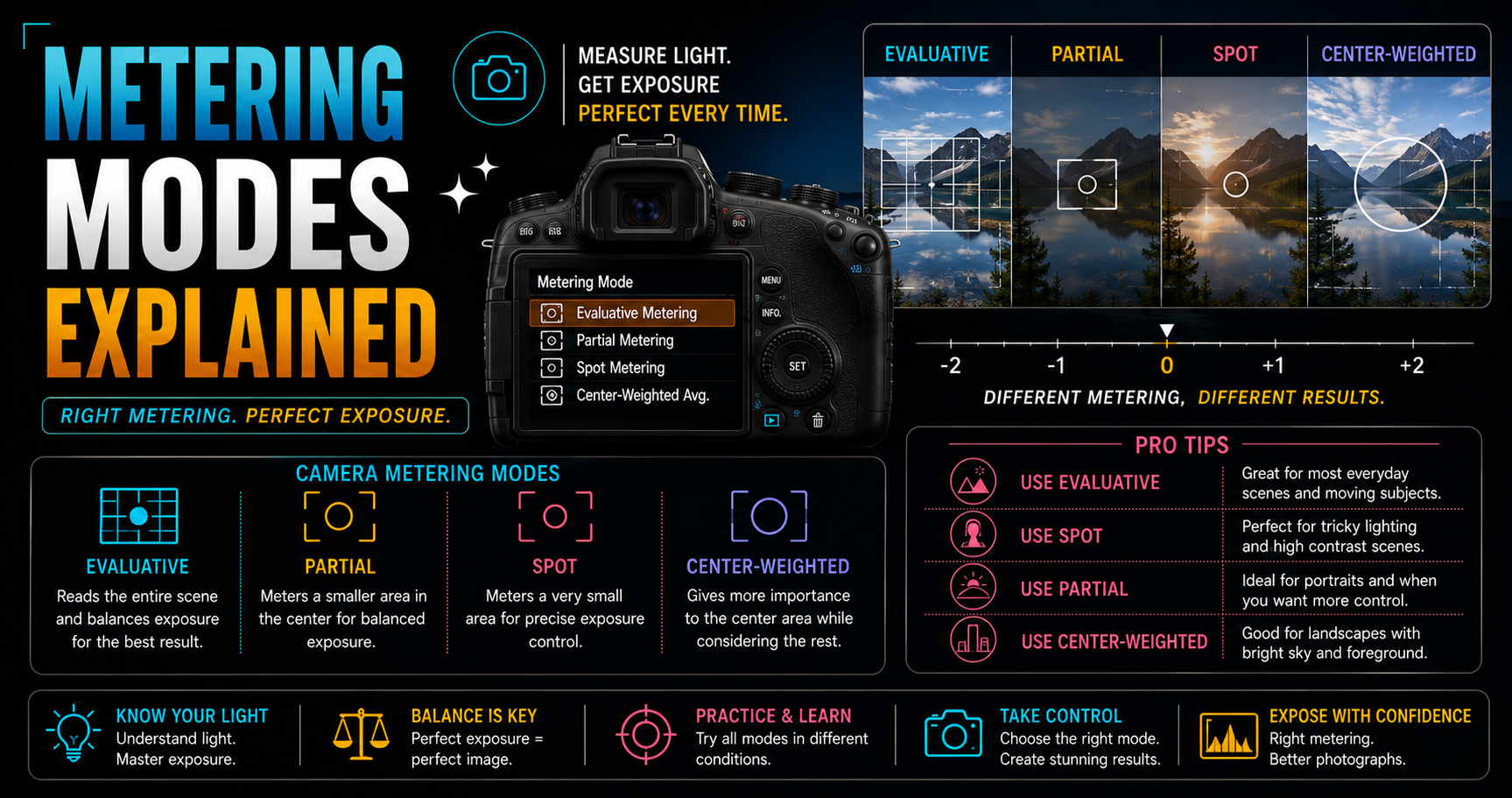
Metering Modes Explained (Complete Beginner’s Guide 2026)
Have you ever taken a photo that looked too bright or too dark, even though your camera was in Auto Mode? This usually happens because the camera measures light differently depending on the scene.
That’s where Metering Modes become important.
Metering modes tell your camera how to measure the light before taking a picture. Choosing the correct metering mode helps you capture better exposures, especially in difficult lighting conditions such as sunsets, backlit portraits, concerts, wildlife, or stage performances.
In this complete guide, you’ll learn:
- What metering modes are
- How your camera measures light
- Types of metering modes
- When to use each mode
- Common mistakes
- Professional exposure tips
Let’s get started.
What is Metering in Photography?
Metering is the process your camera uses to measure the brightness of a scene and calculate the correct exposure.
Before you press the shutter button, the camera analyses the available light and suggests or automatically chooses exposure settings.
The camera tries to create a balanced exposure by deciding how much light should reach the image sensor.
Without proper metering, your photos may become:
- Too bright (Overexposed)
- Too dark (Underexposed)
Understanding metering gives you much more control over your photographs.
Why are Metering Modes Important?
Different scenes have different lighting conditions.
For example:
- A person standing in front of a bright sunset
- A bird against a bright sky
- A bride wearing a white dress
- A singer performing under stage lights
If the camera measures the wrong area, the exposure may not look correct.
Choosing the right metering mode helps your camera prioritise the most important part of the scene.
How Does Camera Metering Work?
Every DSLR and mirrorless camera has a built-in light meter.
The camera analyses the brightness of different areas and calculates an exposure based on the selected metering mode.
Each mode measures light differently.
That is why changing only the metering mode can completely change the final exposure.
Types of Metering Modes
Most cameras include three primary metering modes:
- Matrix (Evaluative) Metering
- Centre-Weighted Metering
- Spot Metering
Some cameras may also offer Partial Metering.
Let’s understand each one.
1. Matrix (Evaluative) Metering
What is Matrix Metering?
Matrix Metering (called Evaluative Metering on Canon cameras) analyses almost the entire frame.
The camera considers:
- Bright areas
- Dark areas
- Subject position
- Focus point
- Overall contrast
It then calculates what it believes is the best overall exposure.
Best For
- Landscapes
- Street Photography
- Travel Photography
- Family Photos
- Everyday Photography
- Beginners
Advantages
- Easy to use
- Works well in most situations
- Balanced exposure
- Fast and reliable
Limitations
In very high-contrast scenes, it may expose for the overall image instead of your main subject.
2. Centre-Weighted Metering
What is Centre-Weighted Metering?
Centre-Weighted Metering gives the greatest importance to the centre of the frame while still considering the surrounding areas.
The subject placed in the centre has the biggest influence on exposure.
Best For
- Portrait Photography
- Product Photography
- Food Photography
- Indoor Photography
Advantages
- Better control over the main subject
- Consistent portrait exposure
- Easy to understand
Limitations
If your subject is near the edge of the frame, exposure may be less accurate.
3. Spot Metering
What is Spot Metering?
Spot Metering measures light from a very small area of the frame (typically around 1–5%, depending on the camera model).
The rest of the image has little or no effect on the exposure calculation.
Best For
- Wildlife Photography
- Bird Photography
- Moon Photography
- Concert Photography
- Stage Performances
- Backlit Portraits
- Macro Photography
Advantages
- Extremely accurate for small subjects
- Excellent in difficult lighting
- Gives photographers precise exposure control
Limitations
If you meter from the wrong part of the scene, the entire image may be overexposed or underexposed.
4. Partial Metering (Available on Some Cameras)
Partial Metering measures a larger area than Spot Metering but a smaller area than Centre-Weighted Metering.
It is useful for subjects that occupy more space than a tiny spot but still need priority over the background.
Best For
- Backlit portraits
- Wildlife
- Stage performances
Comparison of Metering Modes
| Metering Mode | Measures | Best For |
|---|---|---|
| Matrix / Evaluative | Entire frame | Everyday photography |
| Centre-Weighted | Centre area | Portraits |
| Spot | Small focus area | Wildlife, moon, concerts |
| Partial | Medium centre area | Backlit subjects |
Learn Metering Modes Through Practical Experience
Reading about metering modes is useful, but learning how to apply them in real-world situations makes the biggest difference.
At Sharanya Institute Of Photography, under the expert guidance of Shrinivas Javanjal, students practise metering techniques during portrait sessions, wedding shoots, wildlife photography, landscape projects, studio lighting, and outdoor assignments.
Our Online and Offline Diploma in Photography & Wedding Cinematography Courses provide hands-on training in Manual Mode, metering, exposure control, lighting, composition, editing, and professional workflows. If you want to become a professional photographer, cinematographer, or editor, practical experience with real clients and projects will help you build confidence and industry-ready skills.
Which Metering Mode Should You Use?
Landscape Photography
✅ Matrix Metering
The camera balances exposure across the entire scene.
Portrait Photography
✅ Centre-Weighted Metering
The subject’s face becomes the priority.
Wildlife Photography
✅ Spot Metering
Measure light directly from the animal or bird.
Moon Photography
✅ Spot Metering
The moon is much brighter than the surrounding night sky, so spot metering helps expose it correctly.
Wedding Photography
✅ Matrix Metering for general scenes.
✅ Spot Metering for difficult lighting, such as backlit ceremonies or stage lighting.
Concert Photography
✅ Spot Metering
This helps expose performers correctly despite dark backgrounds and bright stage lights.
Metering Modes and Exposure Compensation
Metering and Exposure Compensation (±EV) work together.
For example:
- Bright snow scene → Add +1 EV if your subject appears too dark.
- Dark background → Reduce exposure if highlights begin to clip.
Learning both tools gives you much greater exposure control.
Common Metering Mistakes
Avoid these mistakes:
- Leaving one metering mode selected for every situation.
- Using Spot Metering without understanding where you’re measuring.
- Ignoring the histogram after taking a photo.
- Relying completely on Auto Mode.
- Forgetting to adjust Exposure Compensation when needed.
Practising in different lighting conditions will help you recognise when to change modes.
Professional Metering Tips
- Learn all three main metering modes.
- Check the histogram after important shots.
- Use Spot Metering in high-contrast scenes.
- Use Matrix Metering for everyday photography.
- Keep your subject in mind when choosing a metering mode.
- Shoot in RAW for greater flexibility during editing.
- Review your images and adjust if the exposure isn’t accurate.
Frequently Asked Questions (FAQs)
What is the best metering mode for beginners?
Matrix (Evaluative) Metering is the best choice because it performs well in most situations.
Which metering mode is best for portraits?
Centre-Weighted Metering is a great option because it prioritises the subject in the centre of the frame.
When should I use Spot Metering?
Use Spot Metering when photographing wildlife, birds, concerts, the moon, or subjects in strong backlighting.
Is Matrix Metering always accurate?
It works well in most situations, but high-contrast scenes may require Spot Metering or Exposure Compensation.
Should I shoot in RAW?
Yes. RAW files provide more flexibility for recovering highlights, adjusting shadows, and correcting exposure during editing.
Final Thoughts
Understanding camera metering modes is a major step towards mastering exposure. Instead of relying entirely on Auto Mode, you’ll know how your camera measures light and which mode works best for different subjects.
Start with Matrix Metering for everyday photography, experiment with Centre-Weighted Metering for portraits, and use Spot Metering for challenging lighting conditions. With regular practice, choosing the correct metering mode will become second nature and significantly improve your photographs.
If you’re serious about becoming a professional photographer, cinematographer, or editor, Sharanya Institute Of Photography offers Online and Offline Diploma in Photography & Wedding Cinematography Courses under the mentorship of Shrinivas Javanjal. Through live projects, outdoor shoots, studio practice, editing workshops, and expert guidance, you’ll master exposure, lighting, composition, and advanced photography techniques needed for a successful creative career.
Tags:
You May Also Like
-
Jul 24, 2026
-
Jul 24, 2026
-
Jul 24, 2026
-
Jul 24, 2026
Sign up to receive our latest updates
Get in touch
Call us directly?
+91 9769533675
Address
Office No 9, First floor, Sudama Tower, Kasturi Plaza, Dombivli (E)
support@photovideocourse.com
Popular Courses

- © 2026 Sharanya Institute Of Photography All rights reserved.