
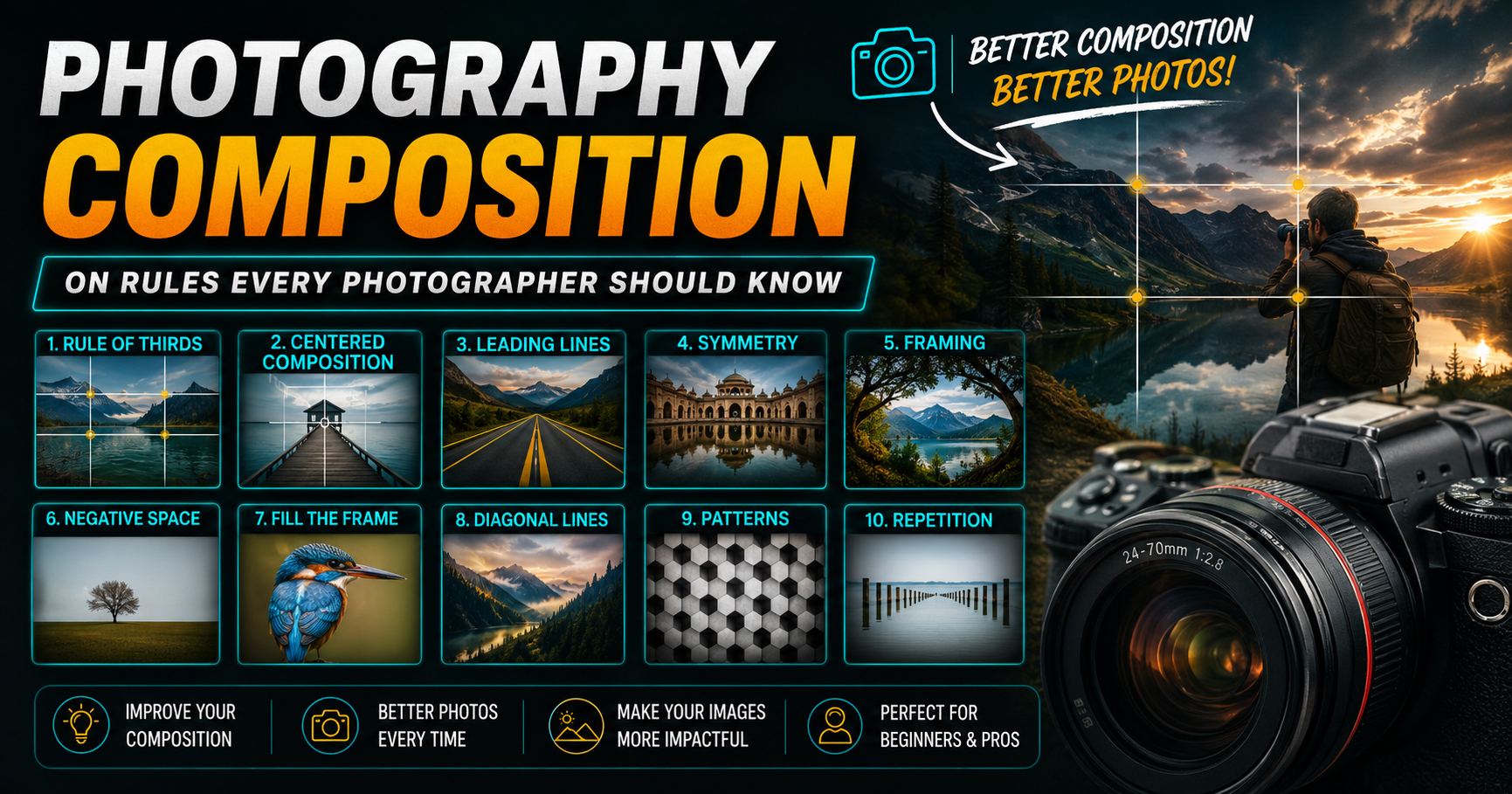
Photography composition on Rules Every Photographer Should Know
-
July 24, 2026
Photography Composition Rules Every Photographer Should Know (Complete Guide 2026)
Have you ever looked at a photograph and wondered why it feels so powerful, balanced, or visually pleasing?
The answer often lies in composition.
A professional camera alone doesn’t create great photographs. The way you arrange your subject and the elements inside the frame is what makes an image stand out. Even with a basic camera or smartphone, strong composition can turn an ordinary photo into an extraordinary one.
In this guide, you’ll learn the most important photography composition rules, how to apply them, and when it’s okay to break them for creative results.
What is Composition in Photography?
Photography composition is the way you arrange your subject and other visual elements within the frame.
Good composition helps:
- Guide the viewer’s eyes.
- Highlight the main subject.
- Create balance and harmony.
- Add depth and storytelling.
- Make photos more interesting and professional.
Think of composition as the language that helps your photograph communicate a story.
Why is Composition Important?
Even with perfect camera settings, poor composition can make a photo look ordinary.
Good composition helps you:
- Capture attention instantly.
- Tell a stronger story.
- Create emotional impact.
- Make subjects stand out.
- Improve overall image quality without expensive equipment.
Professional photographers spend as much time thinking about composition as they do about camera settings.
1. Rule of Thirds
The Rule of Thirds is one of the first composition techniques every beginner should learn.
Imagine dividing your frame into nine equal sections using two horizontal and two vertical lines.
Place your subject where these lines intersect instead of directly in the center.
Best For
- Portraits
- Landscapes
- Travel Photography
- Wildlife
- Street Photography
Why It Works
It creates a balanced image that feels more natural and visually appealing.
2. Leading Lines
Leading lines guide the viewer’s eyes toward your subject.
Examples include:
- Roads
- Rivers
- Railway tracks
- Bridges
- Fences
- Hallways
Best For
- Landscapes
- Architecture
- Travel
- Street Photography
Leading lines create movement and naturally draw attention to the subject.
3. Framing
Use objects around your subject to create a natural frame.
Examples:
- Doors
- Windows
- Trees
- Arches
- Tunnels
Framing adds depth and directs the viewer’s focus.
4. Symmetry and Patterns
The human eye naturally enjoys symmetry.
Look for:
- Reflections
- Buildings
- Staircases
- Bridges
- Repeating shapes
Patterns create rhythm, while symmetry adds balance and elegance.
5. Fill the Frame
Move closer to your subject instead of leaving unnecessary empty space.
This technique helps:
- Remove distractions.
- Show details.
- Increase emotional impact.
It’s especially effective for portraits, wildlife, and product photography.
6. Use Negative Space
Negative space is the empty area around your subject.
It helps:
- Simplify the image.
- Make the subject stand out.
- Create a clean and modern look.
Negative space is often used in minimalist photography.
7. Background Matters
Many beginners focus only on the subject and forget to check the background.
Before taking a photo, ask yourself:
- Are there distracting objects?
- Is the background clean?
- Does it support the story?
A simple background often creates a stronger image.
8. Change Your Perspective
Don’t always shoot from eye level.
Try:
- Low-angle shots.
- High-angle shots.
- Side views.
- Bird’s-eye view.
- Ground-level perspective.
Changing your viewpoint can completely transform an ordinary scene.
Learn Composition Through Practical Training
Composition is not just a theory—it improves through observation, practice, and feedback.
At Sharanya Institute Of Photography, under the guidance of Shrinivas Javanjal, students learn composition through real outdoor shoots, portrait sessions, wedding photography, wildlife assignments, and cinematography projects.
Our Online and Offline Diploma in Photography & Wedding Cinematography Courses focus on practical learning, helping students master composition, camera settings, lighting, editing, storytelling, and professional workflows.
If you want to build a successful career as a photographer, cinematographer, or editor, structured hands-on training can help you develop skills much faster than learning alone.
9. Use Depth in Your Photos
Great photos often include:
- Foreground
- Middle Ground
- Background
Adding layers creates a stronger sense of depth and makes the image feel more immersive.
10. Balance Your Composition
If your main subject is positioned on one side of the frame, consider balancing the image with another visual element on the opposite side.
This creates harmony without making the composition feel crowded.
11. Keep the Horizon Straight
A tilted horizon is one of the most common beginner mistakes.
Always check the horizon line, especially in:
- Landscape Photography
- Beach Photography
- Architecture
- Travel Photography
A level horizon instantly improves the professionalism of your images.
12. Simplify the Scene
Less is often more.
Before pressing the shutter:
- Remove unnecessary objects.
- Change your angle if needed.
- Focus on the most important element.
Simple compositions are often the most powerful.
13. Use Natural Light Creatively
Composition isn’t only about object placement—it also includes light.
Look for:
- Golden Hour light
- Window light
- Side lighting
- Backlighting
- Silhouettes
Light can guide attention just as effectively as lines or framing.
14. Create Visual Balance with Colors
Bright or contrasting colors naturally attract attention.
Use complementary colors to create visually pleasing compositions.
Examples:
- Blue and Orange
- Yellow and Purple
- Red and Green
Color balance enhances the overall impact of your photographs.
15. Break the Rules Creatively
Once you understand the basic composition rules, don’t be afraid to break them intentionally.
Many award-winning photographs succeed because they use unconventional framing, unusual perspectives, or centered compositions to tell a stronger story.
Knowing the rules gives you the confidence to bend them creatively.
Best Composition Techniques for Different Photography Styles
| Photography Type | Recommended Composition |
|---|---|
| Portrait | Rule of Thirds, Fill the Frame, Negative Space |
| Landscape | Leading Lines, Foreground Interest, Straight Horizon |
| Wildlife | Rule of Thirds, Eye-Level Perspective |
| Wedding | Framing, Leading Lines, Natural Light |
| Street | Layers, Symmetry, Candid Moments |
| Product | Symmetry, Clean Background, Fill the Frame |
| Food | Top View, Negative Space, Color Balance |
| Travel | Leading Lines, Rule of Thirds, Wide Perspective |
Common Composition Mistakes
Avoid these beginner mistakes:
- Placing every subject in the center.
- Ignoring distracting backgrounds.
- Cropping important body parts awkwardly.
- Tilting the horizon unintentionally.
- Including unnecessary objects in the frame.
- Forgetting to leave space for movement.
- Using the same angle for every photo.
Recognizing these habits is the first step toward improving your photography.
Professional Composition Tips
- Walk around your subject before taking the photo.
- Take multiple compositions of the same scene.
- Use grid lines on your camera or smartphone.
- Study the work of professional photographers.
- Practice one composition rule at a time.
- Review your photos and identify what works best.
With regular practice, good composition becomes instinctive.
Frequently Asked Questions (FAQs)
What is the most important composition rule?
The Rule of Thirds is often the first rule beginners learn because it creates balanced and visually appealing photographs.
Can I break composition rules?
Yes. Once you understand why the rules work, you can break them intentionally to create unique and creative images.
Does composition matter more than camera settings?
Both are important, but strong composition can make a simple photo look outstanding even with basic equipment.
How do I improve my composition?
Practice regularly, study professional photographs, use grid lines, and experiment with different angles and framing techniques.
Is composition important for videography too?
Absolutely. Composition plays a major role in cinematography by guiding the viewer’s attention and enhancing storytelling.
Final Thoughts
Photography composition is one of the most valuable skills every photographer should master. While camera settings control exposure and sharpness, composition determines how your audience experiences the image.
Start by learning the Rule of Thirds, Leading Lines, Framing, and Negative Space. As your confidence grows, experiment with different perspectives and don’t be afraid to develop your own creative style. Remember, the goal isn’t just to take pictures—it’s to tell stories through every frame.
If you’re passionate about becoming a professional photographer, cinematographer, or editor, Sharanya Institute Of Photography offers Online and Offline Diploma in Photography & Wedding Cinematography Courses under the expert mentorship of Shrinivas Javanjal. Through practical assignments, live projects, and personalized guidance, you’ll gain the technical and creative skills needed to build a successful career in the visual arts.
Tags:
You May Also Like
-
Jul 24, 2026
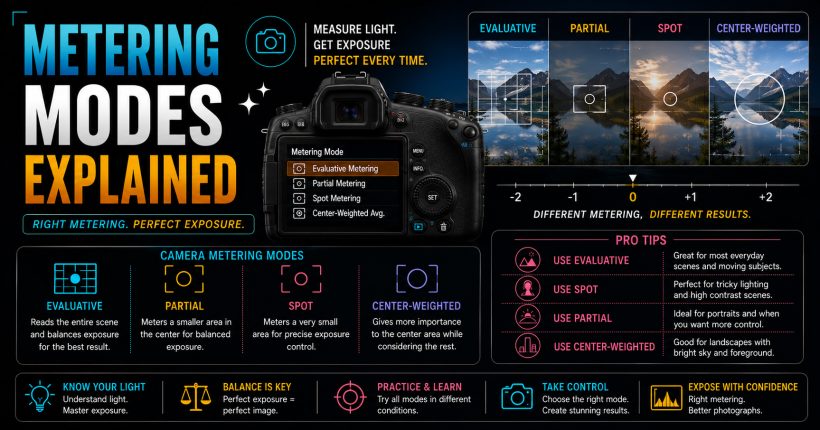
Learn camera metering modes, exposure measurement, and professional techniques to capture perfectly exposed photographs in every lighting condition with confidence.
-
Jul 24, 2026
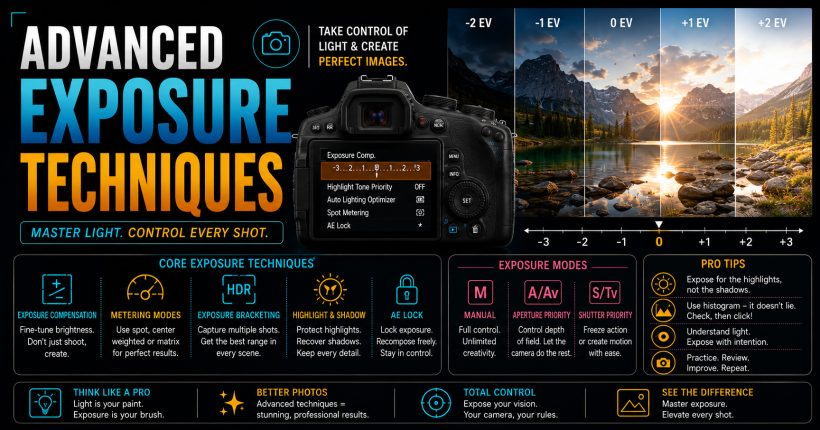
Master advanced exposure techniques using histograms, metering, exposure compensation, and bracketing to capture perfectly exposed professional-quality photographs every time.

-
Jul 24, 2026
Learn panorama photography with simple camera settings, stitching techniques, and professional tips to capture breathtaking wide-angle landscapes and cityscapes effortlessly.
-
Jul 24, 2026
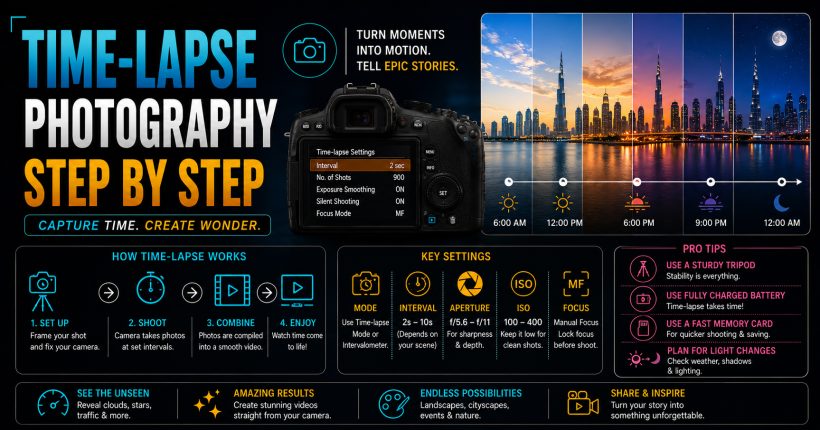
Learn time-lapse photography with simple camera settings, interval techniques, editing workflow, and expert tips for creating stunning cinematic videos effortlessly.
Sign up to receive our latest updates
Get in touch
Call us directly?
+91 9769533675
Address
Office No 9, First floor, Sudama Tower, Kasturi Plaza, Dombivli (E)
support@photovideocourse.com
Popular Courses

- © 2026 Sharanya Institute Of Photography All rights reserved.