
What is Depth of Field? Complete Beginner’s Guide (2026)
Have you ever wondered why some photos have a beautifully blurred background while others keep everything from front to back perfectly sharp?
The answer is Depth of Field (DOF).
Understanding Depth of Field is one of the most important photography skills because it helps you control where your viewer’s attention goes. Whether you’re taking portraits, landscapes, wildlife photos, product shots, or cinematic videos, mastering Depth of Field will instantly make your images look more professional.
In this complete guide, you’ll learn:
- What Depth of Field means
- Shallow vs Deep Depth of Field
- What affects Depth of Field
- How aperture changes background blur
- Best camera settings for different photography styles
- Common beginner mistakes
- Professional tips for controlling focus
Let’s dive in.
What is Depth of Field?
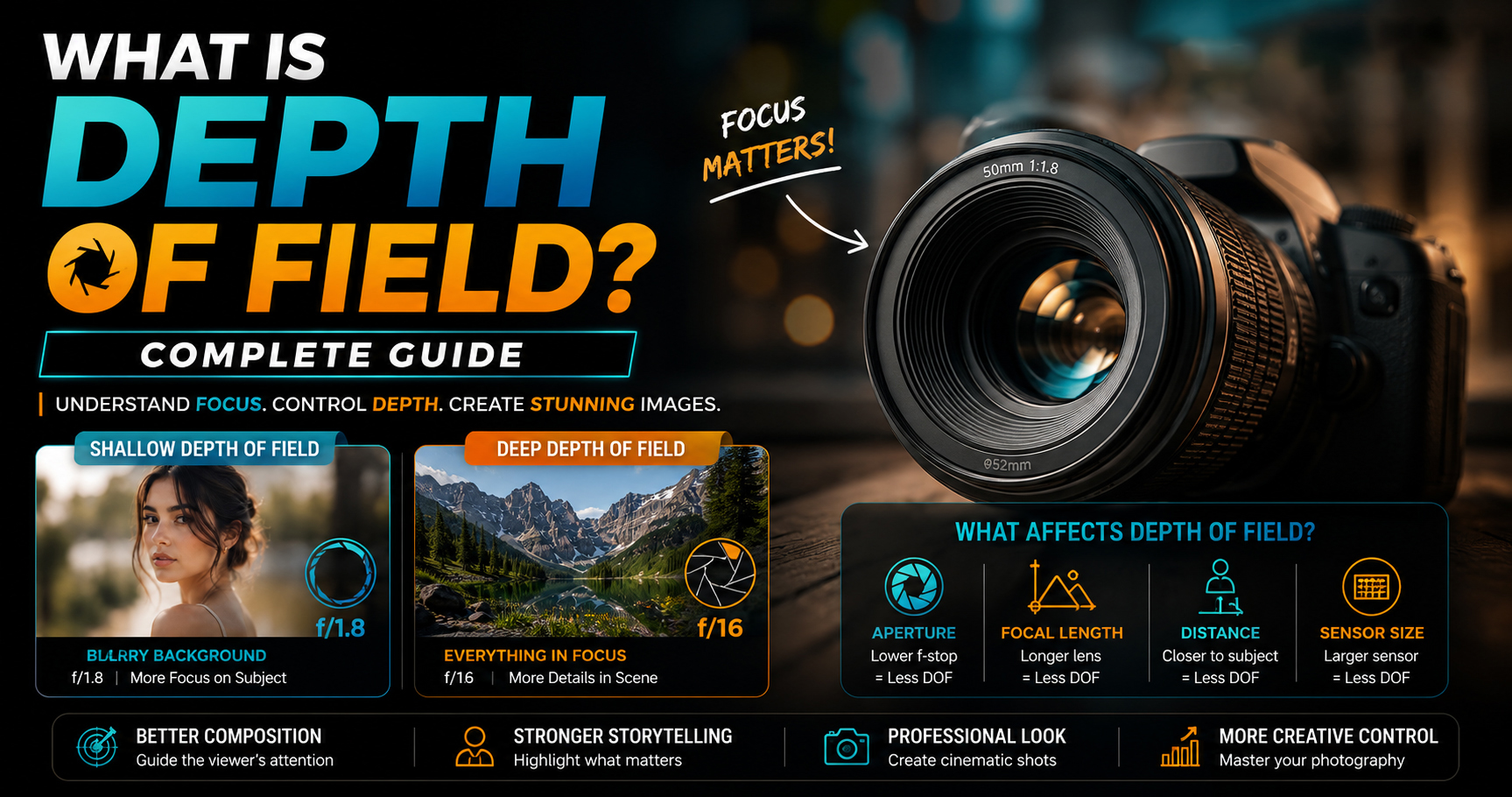
Depth of Field (DOF) is the area of a photograph that appears acceptably sharp and in focus.
Anything outside this focused area gradually becomes blurred.
Simply put:
- Small Depth of Field = Only a small part of the image is sharp.
- Large (Deep) Depth of Field = Most or all of the image is sharp.
Depth of Field is a creative tool that helps photographers decide what viewers notice first.
Understanding Depth of Field with a Simple Example
Imagine you’re taking a portrait of a friend in a park.
Small (Shallow) Depth of Field
- Your friend’s face is perfectly sharp.
- Trees and background become soft and blurry.
- The subject stands out clearly.
This is commonly used in portrait photography.
Large (Deep) Depth of Field
- Your friend is sharp.
- Trees are sharp.
- Mountains are sharp.
- Everything from front to back appears in focus.
This is ideal for landscape photography.
What Controls Depth of Field?
Three main factors affect Depth of Field:
- Aperture
- Focal Length
- Distance from the Subject
Let’s understand each one.
1. Aperture and Depth of Field
Aperture has the biggest influence on Depth of Field.
Wide Aperture (Small f-number)
Examples:
- f/1.4
- f/1.8
- f/2
- f/2.8
Results:
- More light enters the lens.
- Strong background blur.
- Shallow Depth of Field.
- Perfect for portraits and low-light photography.
Narrow Aperture (Large f-number)
Examples:
- f/8
- f/11
- f/16
Results:
- Less light enters the lens.
- More of the scene stays sharp.
- Deep Depth of Field.
- Ideal for landscapes, architecture, and group photos.
2. Focal Length and Depth of Field
Longer focal lengths naturally create more background blur.
Wide-Angle Lens
Example:
16mm
- Larger Depth of Field.
- More of the scene appears sharp.
Best for:
- Landscapes
- Travel
- Architecture
Telephoto Lens
Example:
200mm
- Strong background blur.
- Better subject isolation.
Best for:
- Portraits
- Wildlife
- Sports
3. Distance from Your Subject
The closer you are to your subject:
- The blurrier the background becomes.
- The shallower the Depth of Field.
The farther you stand:
- More of the scene remains in focus.
This is why macro photography often has an extremely shallow Depth of Field.
Shallow Depth of Field
A Shallow Depth of Field means only a small portion of the image is in focus.
Best For
- Portrait Photography
- Wedding Photography
- Wildlife Photography
- Product Photography
- Food Photography
- Cinematic Videos
Benefits
- Beautiful background blur (Bokeh)
- Strong subject separation
- Professional-looking images
- Better storytelling by directing the viewer’s attention
Deep Depth of Field
A Deep Depth of Field keeps most or all of the image in focus.
Best For
- Landscape Photography
- Architecture
- Real Estate Photography
- Travel Photography
- Group Photos
Benefits
- Sharp details throughout the frame
- Greater sense of depth and scale
- Ideal for scenes where every element is important
Learn Professional Camera Techniques
Understanding Depth of Field is one of the most important milestones in photography, but applying it effectively requires hands-on practice.
At Sharanya Institute Of Photography, led by Shrinivas Javanjal, students learn how to control Depth of Field in portraits, weddings, wildlife photography, product photography, and cinematography through practical assignments and live shooting sessions.
Our Online and Offline Diploma in Photography & Wedding Cinematography Courses are designed for beginners and aspiring professionals. Students gain real-world experience with camera settings, lighting, lens selection, editing, color grading, and industry-standard workflows.
If your dream is to become a professional photographer, cinematographer, or editor, structured training can help you build confidence, creativity, and career-ready skills.
Best Camera Settings for Different Depth of Field Effects
Portrait Photography
- Aperture: f/1.8–f/2.8
- Lens: 50mm or 85mm
- Focus: Eyes
- ISO: 100–400
- Shutter Speed: 1/200 sec
Result:
Beautiful blurred background with a sharp subject.
Landscape Photography
- Aperture: f/8–f/11
- Lens: 16–35mm
- ISO: 100
- Tripod: Recommended
Result:
Sharp foreground, middle ground, and background.
Product Photography
- Aperture: f/8–f/11
- Tripod: Yes
- Manual Focus: Recommended
Result:
Maximum product sharpness.
Wildlife Photography
- Aperture: f/4–f/5.6
- Telephoto Lens
- Fast Shutter Speed
- Continuous Autofocus
Result:
Sharp animal with pleasing background separation.
Common Beginner Mistakes
Avoid these mistakes:
- Using f/1.8 for every photo, even when more depth is needed.
- Standing too far from the subject when trying to blur the background.
- Choosing the wrong focal length.
- Forgetting that aperture affects both exposure and Depth of Field.
- Missing focus on the subject’s eyes in portraits.
- Expecting background blur with a wide-angle lens from far away.
Understanding how these factors interact will improve your results significantly.
Professional Tips for Better Depth of Field
- Move closer to your subject for stronger background blur.
- Increase the distance between your subject and the background.
- Use a longer focal length for portraits.
- Choose wider apertures for cinematic images.
- Use narrower apertures for landscapes.
- Focus carefully—especially on the eyes in portrait photography.
- Practice in different lighting conditions to see how DOF changes.
Frequently Asked Questions (FAQs)
What is Depth of Field in simple words?
Depth of Field is the area of a photo that appears sharp and in focus. Everything outside that area becomes progressively blurred.
Which aperture creates the most background blur?
Wide apertures such as f/1.4, f/1.8, and f/2.8 create the strongest background blur.
Which aperture is best for landscapes?
Most landscape photographers use f/8 to f/11 to keep as much of the scene in focus as possible.
Does focal length affect Depth of Field?
Yes. Longer focal lengths generally create stronger background blur and better subject separation.
Is Depth of Field important for video?
Absolutely. Cinematographers use Depth of Field to guide the viewer’s attention, create mood, and achieve a cinematic look.
Final Thoughts
Depth of Field is one of the most creative tools available to photographers and filmmakers. Once you understand how aperture, focal length, and subject distance work together, you’ll be able to control focus intentionally instead of relying on luck.
Practice creating both shallow and deep Depth of Field in different situations. Experiment with different lenses and apertures, and review your results carefully. As your understanding grows, your photos and videos will become more visually engaging and professional.
If you’re ready to take your photography and cinematography skills to the next level, Sharanya Institute Of Photography offers Online and Offline Diploma in Photography & Wedding Cinematography Courses under the expert guidance of Shrinivas Javanjal. Through practical training, live projects, and industry-focused instruction, you’ll develop the technical knowledge and creative confidence needed for a successful career.
Tags:
You May Also Like
-
Jul 24, 2026
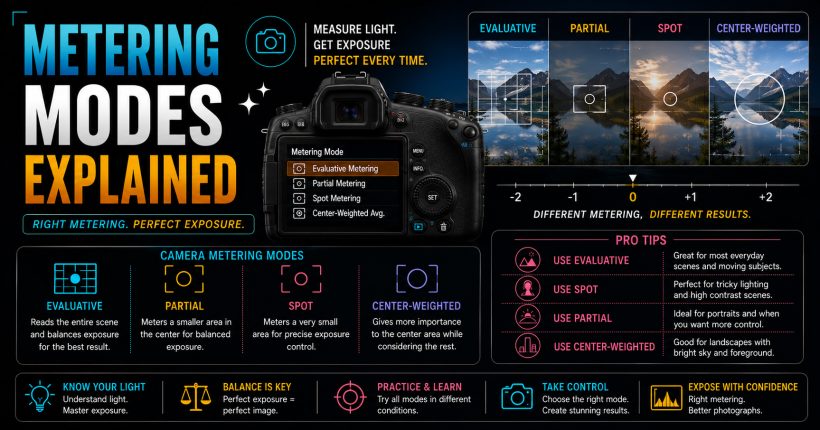
Learn camera metering modes, exposure measurement, and professional techniques to capture perfectly exposed photographs in every lighting condition with confidence.
-
Jul 24, 2026
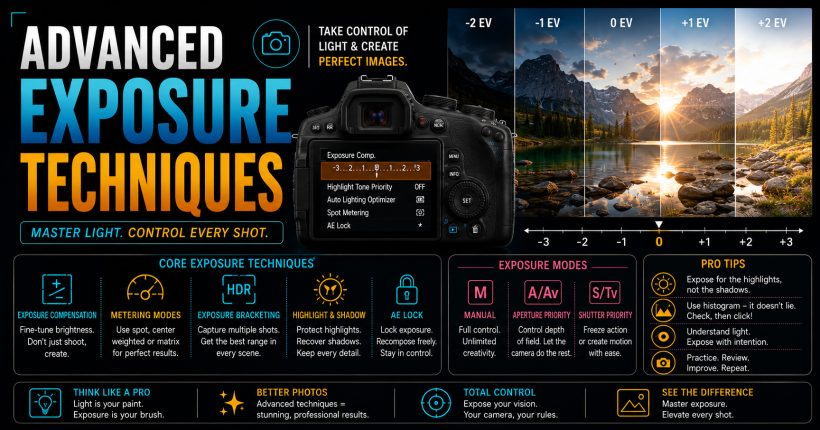
Master advanced exposure techniques using histograms, metering, exposure compensation, and bracketing to capture perfectly exposed professional-quality photographs every time.
-
Jul 24, 2026
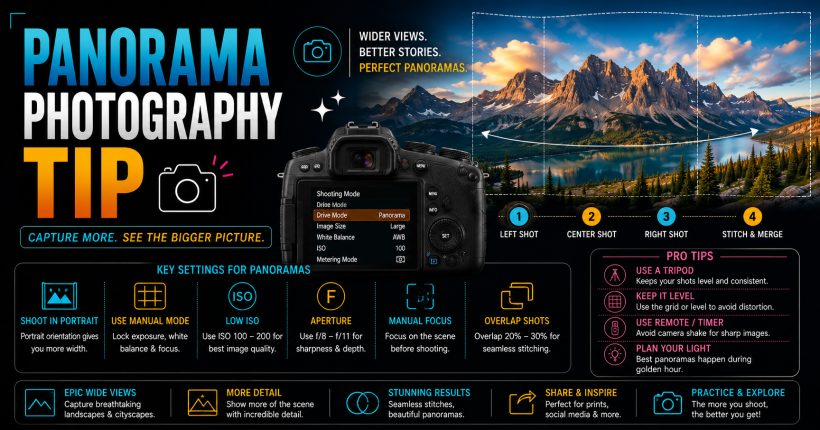
Learn panorama photography with simple camera settings, stitching techniques, and professional tips to capture breathtaking wide-angle landscapes and cityscapes effortlessly.
-
Jul 24, 2026
Learn time-lapse photography with simple camera settings, interval techniques, editing workflow, and expert tips for creating stunning cinematic videos effortlessly.
Sign up to receive our latest updates
Get in touch
Call us directly?
+91 9769533675
Address
Office No 9, First floor, Sudama Tower, Kasturi Plaza, Dombivli (E)
support@photovideocourse.com
Popular Courses

- © 2026 Sharanya Institute Of Photography All rights reserved.