
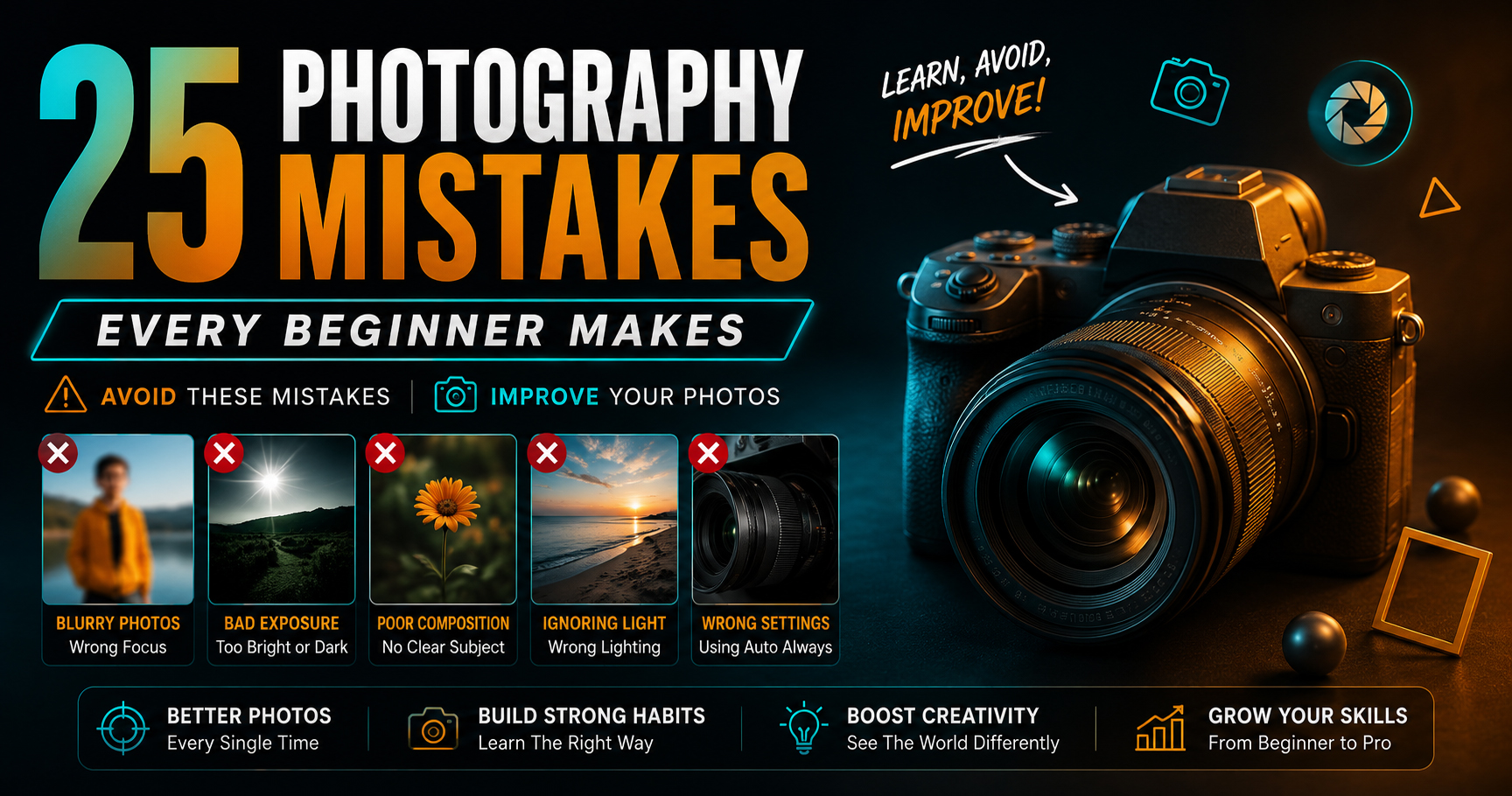
25 Photography Mistakes Every Beginner Makes (And How to Avoid Them)
Every professional photographer started as a beginner—and every beginner makes mistakes.
The good news is that mistakes are one of the fastest ways to learn photography. The key is identifying them early and correcting them before they become habits.
Whether you use a DSLR, mirrorless camera, or even a smartphone, avoiding these common mistakes will help you capture sharper, more creative, and professional-looking photos.
Let’s explore the 25 most common photography mistakes and learn how to avoid them.
1. Shooting Only in Auto Mode
Auto Mode is useful for quick snapshots, but it limits your creative control.
Solution: Learn Aperture, Shutter Speed, and ISO so you can confidently use Manual Mode.
2. Ignoring Lighting
Photography is the art of capturing light.
Even an expensive camera cannot produce great images in poor lighting.
Solution: Learn to observe natural light and shoot during the Golden Hour whenever possible.
3. Holding the Camera Incorrectly
A poor grip causes blurry photos due to camera shake.
Solution: Hold the camera with both hands, support the lens from underneath, and keep your elbows close to your body.
4. Using Very Slow Shutter Speeds
Many beginners accidentally introduce motion blur.
Solution: Use a faster shutter speed when photographing moving subjects or shooting handheld.
5. Keeping ISO Too High
High ISO increases digital noise.
Solution: Use the lowest ISO that still allows a proper exposure.
6. Forgetting About Composition
A technically correct photo can still look boring.
Solution: Practice the Rule of Thirds, Leading Lines, Framing, Symmetry, and Negative Space.
7. Always Shooting at the Widest Aperture
Using f/1.8 for every photo isn’t always the best choice.
Solution: Select the aperture based on the subject. Landscapes often require f/8 to f/11, while portraits may benefit from wider apertures.
8. Not Cleaning the Lens
Dust, fingerprints, and smudges reduce image quality.
Solution: Clean your lens regularly using a microfiber cloth and proper lens-cleaning tools.
9. Buying Expensive Gear Too Early
Many beginners think better equipment automatically means better photos.
Solution: Invest in learning and practice before upgrading your camera.
Want to Become a Professional Photographer or Cinematographer?
Avoiding mistakes is only part of becoming a professional. The fastest improvement comes from learning under experienced mentors, practicing regularly, and receiving constructive feedback.
At Sharanya Institute Of Photography, led by Shrinivas Javanjal, students learn photography through live assignments, outdoor shoots, studio sessions, wedding projects, editing workflows, and real-world client scenarios.
We offer Online and Offline Diploma in Photography & Wedding Cinematography Courses, designed for beginners who want to build careers as photographers, cinematographers, or professional editors.
If you’re serious about turning your passion into a profession, structured training can save years of trial and error.
10. Not Learning Manual Mode
Manual Mode gives you full creative control over your images.
Solution: Practice adjusting Shutter Speed, Aperture, and ISO until they become second nature.
11. Ignoring White Balance
Incorrect white balance can make photos appear too blue or too yellow.
Solution: Use Auto White Balance as a starting point, then learn how to adjust it manually when needed.
12. Forgetting to Check Focus
A beautiful composition is useless if the subject isn’t sharp.
Solution: Zoom in after taking important photos and check focus carefully.
13. Overediting Photos
Too much saturation, contrast, or sharpening often makes images look unnatural.
Solution: Edit with a light touch and aim for natural-looking results.
14. Shooting Only One Photo
Professionals rarely rely on a single frame.
Solution: Capture multiple shots with small variations in composition and settings.
15. Ignoring the Background
Distracting objects can ruin an otherwise great portrait.
Solution: Look around your subject before pressing the shutter and simplify the background.
16. Not Using RAW Format
JPEG is convenient, but RAW preserves much more image data.
Solution: Shoot in RAW or RAW + JPEG if you plan to edit your photos.
17. Cropping Too Much Later
Heavy cropping reduces image quality.
Solution: Compose your photo carefully while shooting.
18. Forgetting to Back Up Photos
Memory cards can fail unexpectedly.
Solution: Keep at least two backups of your important images.
19. Taking Photos at Eye Level Only
Every photo from the same angle becomes repetitive.
Solution: Try shooting from high, low, or side angles for more dynamic images.
20. Not Practicing Regularly
Photography improves through repetition.
Solution: Carry your camera often and challenge yourself with different subjects and lighting conditions.
21. Ignoring the Histogram
The LCD screen can be misleading in bright sunlight.
Solution: Learn to read the histogram to judge exposure more accurately.
22. Using the Wrong Lens
Different subjects require different focal lengths.
Solution: Choose a lens that matches your subject instead of relying on one lens for everything.
23. Being Afraid to Experiment
Creativity comes from trying new ideas.
Solution: Test different camera settings, lighting styles, and compositions without worrying about making mistakes.
24. Comparing Yourself to Professionals Too Early
Social media often showcases only the final polished result.
Solution: Focus on improving your own skills instead of comparing your beginning to someone else’s experience.
25. Giving Up Too Soon
Every photographer experiences disappointing shoots.
The difference is that professionals keep learning and practicing.
Solution: Stay patient, enjoy the process, and celebrate small improvements.
Bonus Tips to Improve Faster
If you want to accelerate your learning:
- Photograph something every day.
- Analyze your favorite photographers’ work.
- Study light before studying equipment.
- Learn editing alongside photography.
- Join photography communities.
- Accept constructive criticism.
- Build a portfolio from your best work.
- Practice storytelling through your images.
Frequently Asked Questions (FAQs)
Is it normal to make mistakes as a beginner?
Yes. Every professional photographer started by making mistakes. Learning from them is an essential part of improving your skills.
What’s the biggest beginner mistake?
Relying only on Auto Mode and not learning the basics of Shutter Speed, Aperture, and ISO.
Does expensive equipment guarantee better photos?
No. Knowledge of light, composition, timing, and storytelling has a much greater impact than expensive gear.
How can I improve my photography quickly?
Practice consistently, study the work of experienced photographers, review your own images critically, and seek feedback whenever possible.
Should I learn photo editing too?
Absolutely. Editing is an important part of the digital photography workflow and helps you present your images at their best.
Final Thoughts
Photography isn’t about avoiding every mistake—it’s about learning from each one. Every blurry photo, incorrect exposure, or missed composition teaches you something valuable.
The more you practice, experiment, and understand your camera, the more confident you’ll become. Remember, great photographers aren’t born—they’re made through curiosity, patience, and continuous learning.
If you dream of becoming a professional photographer, wedding cinematographer, or editor, Sharanya Institute Of Photography provides Online and Offline Diploma in Photography & Wedding Cinematography Courses under the expert guidance of Shrinivas Javanjal. You’ll gain practical experience, industry-ready skills, and the confidence to build a successful career in photography and filmmaking.
Tags:
You May Also Like
-
Jul 24, 2026
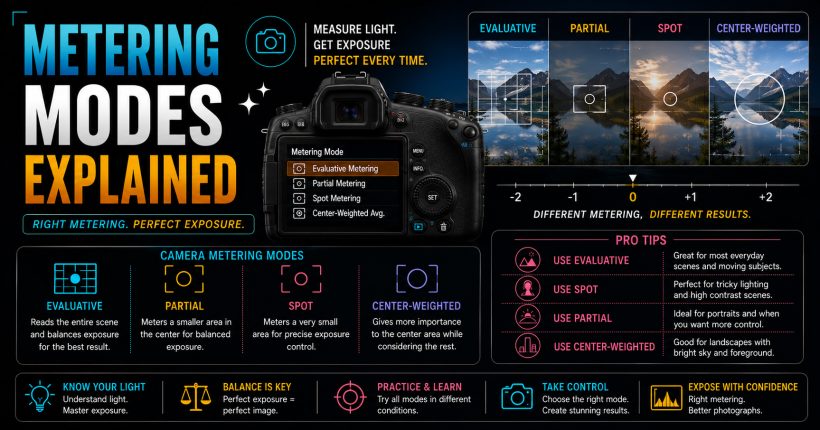
Learn camera metering modes, exposure measurement, and professional techniques to capture perfectly exposed photographs in every lighting condition with confidence.
-
Jul 24, 2026
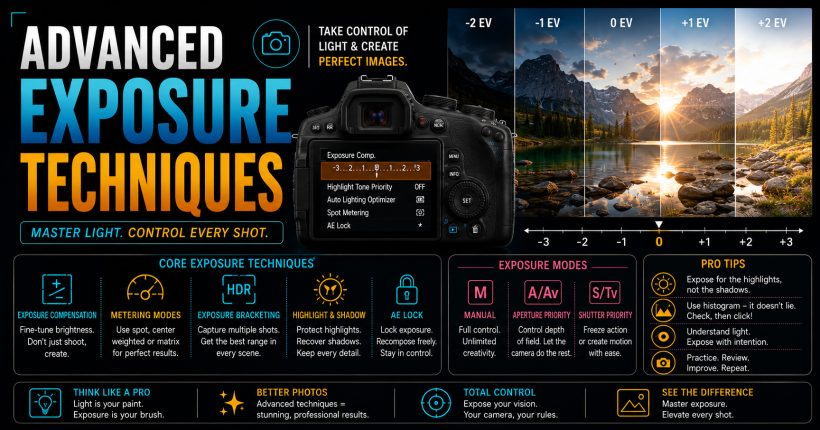
Master advanced exposure techniques using histograms, metering, exposure compensation, and bracketing to capture perfectly exposed professional-quality photographs every time.
-
Jul 24, 2026
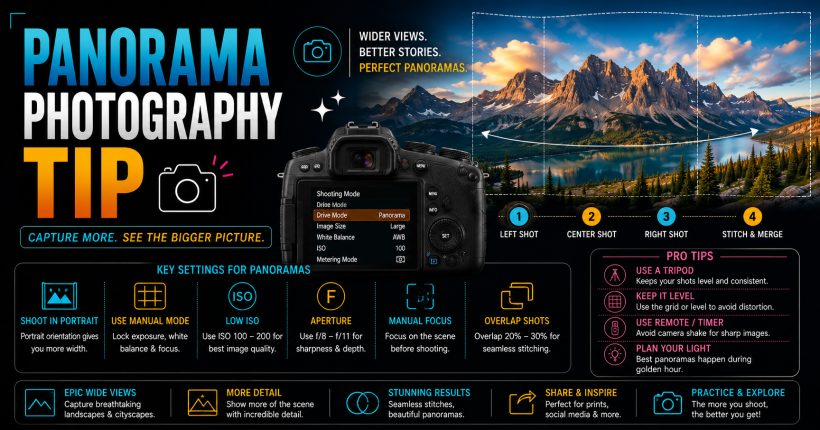
Learn panorama photography with simple camera settings, stitching techniques, and professional tips to capture breathtaking wide-angle landscapes and cityscapes effortlessly.
-
Jul 24, 2026
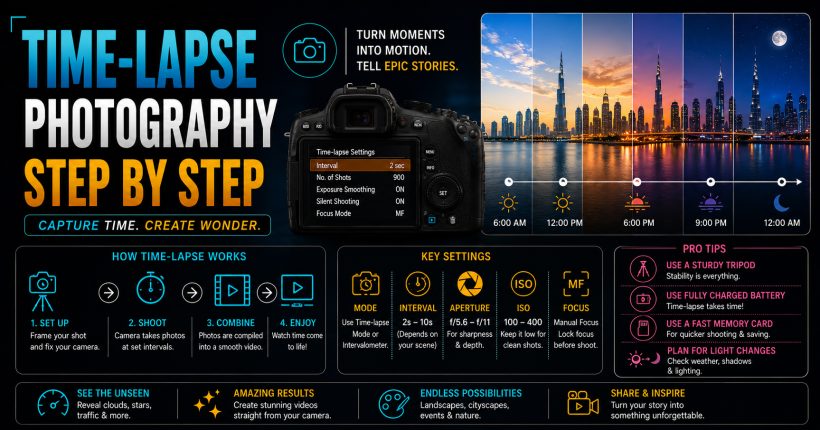
Learn time-lapse photography with simple camera settings, interval techniques, editing workflow, and expert tips for creating stunning cinematic videos effortlessly.
Sign up to receive our latest updates
Get in touch
Call us directly?
+91 9769533675
Address
Office No 9, First floor, Sudama Tower, Kasturi Plaza, Dombivli (E)
support@photovideocourse.com
Popular Courses

- © 2026 Sharanya Institute Of Photography All rights reserved.