
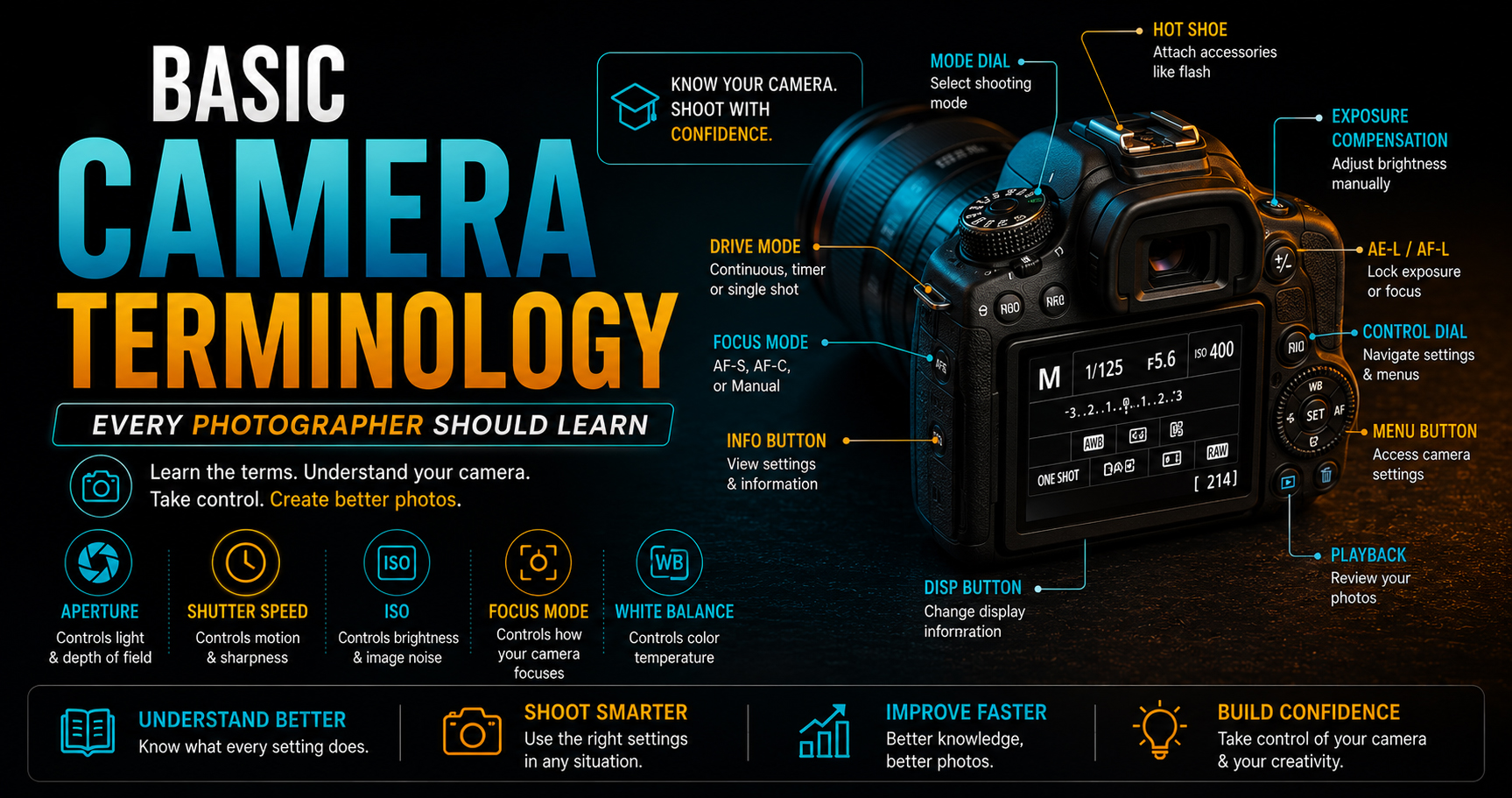
Basic Camera Terminology Every Photographer Should Learn (Complete Guide 2026)
If you’re new to photography, you’ve probably heard words like Aperture, ISO, Shutter Speed, RAW, Bokeh, Autofocus, or White Balance and wondered what they actually mean.
Don’t worry—you don’t need to memorize hundreds of technical terms to become a great photographer.
This guide explains the most important camera and photography terms in simple, easy-to-understand language. Once you understand these basics, learning camera settings and taking better photos becomes much easier.
In this guide, you’ll learn:
- Essential camera terminology
- Photography terms explained simply
- Camera settings vocabulary
- Lens-related terms
- Lighting terms
- File format terms
- Professional photography language
Let’s start with the basics.
1. Aperture
Aperture is the opening inside the camera lens that controls how much light enters the camera.
It is measured using f-numbers like:
- f/1.8
- f/2.8
- f/5.6
- f/11
Simple Example
Think of aperture like the pupil of your eye.
- Large opening = More light
- Small opening = Less light
Aperture also controls Depth of Field, which affects how blurry or sharp the background appears.
2. Shutter Speed
Shutter Speed is the amount of time the camera sensor is exposed to light.
Examples:
- 1/1000 sec
- 1/500 sec
- 1/250 sec
- 1 second
Fast Shutter Speed
Used for:
- Sports
- Wildlife
- Birds
- Action photography
Slow Shutter Speed
Used for:
- Waterfalls
- Night photography
- Light trails
- Creative motion blur
3. ISO
ISO controls how sensitive the camera sensor is to light.
Examples:
- ISO 100
- ISO 400
- ISO 800
- ISO 3200
Lower ISO gives cleaner images, while higher ISO helps in low light but may introduce digital noise.
4. Exposure
Exposure refers to the overall brightness of a photograph.
A properly exposed image is neither too dark nor too bright.
Exposure is controlled by three settings:
- Aperture
- Shutter Speed
- ISO
Together, these are known as the Exposure Triangle.
5. Depth of Field (DOF)
Depth of Field is the area of a photo that appears sharp and in focus.
- Shallow Depth of Field = Blurry background
- Deep Depth of Field = More of the scene stays sharp
Portrait photographers often use shallow DOF, while landscape photographers usually prefer deep DOF.
6. Focal Length
Focal Length is measured in millimeters (mm) and determines how much of the scene your lens captures.
Examples:
- 16mm – Wide-angle
- 35mm – Street photography
- 50mm – Everyday photography
- 85mm – Portraits
- 200mm – Wildlife and sports
7. Prime Lens
A Prime Lens has one fixed focal length, such as 50mm or 85mm.
Advantages
- Sharper images
- Better low-light performance
- Beautiful background blur
- Lightweight design
8. Zoom Lens
A Zoom Lens lets you change focal lengths without changing lenses.
Examples:
- 18–55mm
- 24–70mm
- 70–200mm
Zoom lenses are versatile and ideal for travel, weddings, and events.
9. Autofocus (AF)
Autofocus allows the camera to automatically focus on the subject.
Common autofocus modes include:
- Single AF (AF-S / One Shot)
- Continuous AF (AF-C / AI Servo)
- Automatic AF
Modern mirrorless cameras also offer Eye Detection AF and Subject Tracking for improved accuracy.
10. Manual Focus (MF)
Manual Focus allows the photographer to adjust focus manually using the focus ring on the lens.
It is commonly used for:
- Macro photography
- Product photography
- Astrophotography
- Video production
Learn Photography with Practical Experience
Understanding photography terms is only the first step. The real improvement comes when you apply these concepts during actual photo and video shoots.
At Sharanya Institute Of Photography, led by Shrinivas Javanjal, students learn photography through hands-on practice, including portrait sessions, weddings, wildlife photography, studio lighting, cinematography, and editing projects.
Our Online and Offline Diploma in Photography & Wedding Cinematography Courses are designed for beginners who want to become professional photographers, cinematographers, or editors. You’ll gain practical experience with camera settings, lenses, lighting, composition, color grading, and industry-standard workflows.
Learning by doing helps you understand these camera terms much faster than simply reading about them.
11. White Balance (WB)
White Balance adjusts colors so that white objects appear truly white under different lighting conditions.
Common White Balance modes:
- Auto
- Daylight
- Cloudy
- Shade
- Tungsten
- Fluorescent
Correct White Balance ensures natural-looking colors.
12. RAW
RAW is an unprocessed image file that retains the maximum amount of image data.
Advantages
- Better editing flexibility
- Greater dynamic range
- Higher image quality
- Improved color correction
RAW files are preferred by professional photographers.
13. JPEG
JPEG is a compressed image format that is ready to share immediately.
Advantages
- Smaller file sizes
- Faster workflow
- Compatible with most devices
JPEG is ideal for casual photography and quick sharing.
14. Dynamic Range
Dynamic Range is the camera’s ability to capture details in both the brightest highlights and darkest shadows.
A camera with good dynamic range preserves more detail in high-contrast scenes.
15. Bokeh
Bokeh refers to the attractive quality of the out-of-focus areas in an image.
Beautiful bokeh is often created using:
- Wide apertures (f/1.4–f/2.8)
- Longer focal lengths
- Greater distance between the subject and background
Portrait photographers often use bokeh to make subjects stand out.
16. Histogram
A Histogram is a graph that shows the brightness levels in your photo.
It helps photographers evaluate exposure and avoid losing detail in shadows or highlights.
17. Burst Mode
Burst Mode allows the camera to capture multiple images in rapid succession.
Best for:
- Sports
- Wildlife
- Action photography
- Children
- Events
18. Crop Factor
Crop Factor explains how a smaller camera sensor changes the field of view compared to a Full Frame sensor.
Understanding crop factor helps you choose the right lens for your camera.
19. Hot Shoe
The Hot Shoe is the mount on top of a camera used to attach accessories such as:
- External flash
- Wireless trigger
- Microphone
- LED light
20. Image Stabilization (IS / IBIS)
Image Stabilization reduces blur caused by camera shake.
Types include:
- Lens-based Image Stabilization (IS/VR/OSS)
- In-Body Image Stabilization (IBIS)
This feature is especially useful for handheld photography and videography.
Common Beginner Mistakes
Avoid these common mistakes:
- Confusing aperture with shutter speed.
- Using high ISO in bright daylight.
- Shooting only in Auto mode.
- Ignoring White Balance.
- Believing more megapixels always mean better photos.
- Using JPEG when heavy editing is required.
- Not understanding autofocus modes.
Mastering the basics helps you avoid these errors.
Quick Camera Terminology Cheat Sheet
| Term | Simple Meaning |
|---|---|
| Aperture | Controls light entering the lens |
| Shutter Speed | Controls how long light reaches the sensor |
| ISO | Controls light sensitivity |
| Exposure | Overall brightness of the photo |
| RAW | Uncompressed image file |
| JPEG | Compressed image file |
| Depth of Field | Area that appears in focus |
| Focal Length | Determines field of view |
| White Balance | Adjusts color accuracy |
| Autofocus | Camera focuses automatically |
| Manual Focus | Photographer focuses manually |
| Dynamic Range | Captures shadow and highlight detail |
| Bokeh | Quality of background blur |
| Burst Mode | Rapid continuous shooting |
| Crop Factor | Changes field of view on smaller sensors |
Frequently Asked Questions (FAQs)
What is the most important camera term for beginners?
The Exposure Triangle—Aperture, Shutter Speed, and ISO—is the foundation of photography and should be learned first.
Should beginners shoot RAW or JPEG?
JPEG is convenient for quick sharing, while RAW offers much more flexibility for editing and professional work.
What does mm mean on a lens?
It represents the focal length, which determines how wide or zoomed-in the view appears.
What is the difference between Autofocus and Manual Focus?
Autofocus adjusts focus automatically, while Manual Focus allows the photographer to set focus using the lens.
How can I remember all these camera terms?
Practice them regularly during photo shoots. Applying the concepts in real situations makes them much easier to remember.
Final Thoughts
Learning camera terminology is like learning a new language—but it doesn’t have to be overwhelming. By understanding key concepts such as Aperture, Shutter Speed, ISO, Depth of Field, RAW, White Balance, and Focal Length, you’ll gain confidence using your camera and improve your photography much faster.
Don’t try to memorize every term at once. Learn a few concepts, practice them in real shooting situations, and gradually build your knowledge. Consistent practice is what transforms beginners into skilled photographers.
If you’re serious about becoming a professional photographer, cinematographer, or editor, Sharanya Institute Of Photography offers Online and Offline Diploma in Photography & Wedding Cinematography Courses under the expert guidance of Shrinivas Javanjal. Through practical assignments, live projects, and industry-focused training, you’ll master camera techniques, editing, lighting, composition, and professional workflows.
Tags:
You May Also Like
-
Jul 24, 2026
Learn camera metering modes, exposure measurement, and professional techniques to capture perfectly exposed photographs in every lighting condition with confidence.
-
Jul 24, 2026
Master advanced exposure techniques using histograms, metering, exposure compensation, and bracketing to capture perfectly exposed professional-quality photographs every time.
-
Jul 24, 2026
Learn panorama photography with simple camera settings, stitching techniques, and professional tips to capture breathtaking wide-angle landscapes and cityscapes effortlessly.
-
Jul 24, 2026
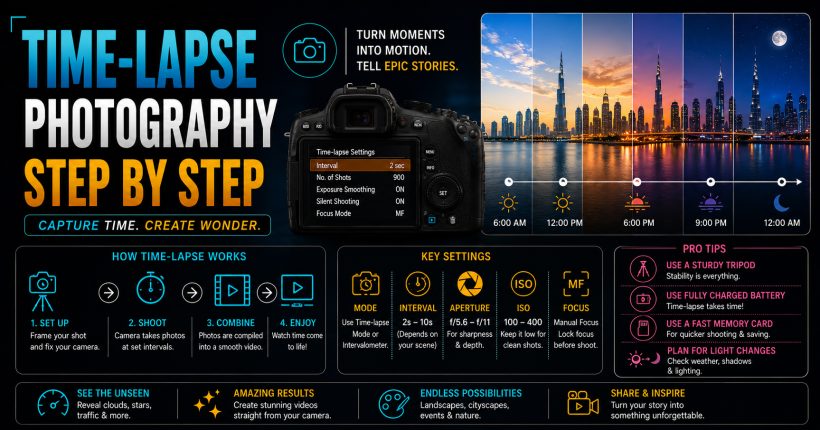
Learn time-lapse photography with simple camera settings, interval techniques, editing workflow, and expert tips for creating stunning cinematic videos effortlessly.
Sign up to receive our latest updates
Get in touch
Call us directly?
+91 9769533675
Address
Office No 9, First floor, Sudama Tower, Kasturi Plaza, Dombivli (E)
support@photovideocourse.com
Popular Courses

- © 2026 Sharanya Institute Of Photography All rights reserved.